
Equity markets rallied after softer-than-expected inflation data in the US and UK rekindled hopes of the end of the rate-hiking cycle by major central banks. The soft inflation reading drove down bond yields and the US dollar, whetting the appetite for risky assets. The 10-year US bond yield fell below 4.5 per cent after topping 5 per cent less than a month ago.

Riding the wave of the equity market, the mutual fund (MF) industry experienced double-digit growth in Samvat 2079, concluding the Hindu calendar year close to the Rs 50 trillion assets under management milestone. After a subdued 6 per cent growth in Samvat 2078, the industry's assets surged over 18 per cent last year to Rs 46.7 trillion. Industry players anticipate that Samvat 2080 will also be a fruitful year for the asset management industry, given the strong inflows from retail investors, particularly through the systematic investment plan route.

IndusInd Bank, Suzlon, and Paytm will remain under focus, as the stocks are pegged to get added to the MSCI global standard index. These stocks, along with six others, are seen attracting cumulative inflows of nearly $2 billion from passive funds tracking MSCI indices. Persistent Systems, APL Apollo, Polycab, Macrotech Developers, Tata Motors DVR, and Tata Communication are the other six stocks that will be added to the MSCI index, shows an analysis done by Nuvama Alternative & Quantitative Research.

Diwali fireworks are expected to continue on Dalal Street next week, with four companies collectively seeking to mobilise over Rs 6,600 crore through initial public offerings (IPOs). In terms of the amount raised, this is poised to be the busiest week of calendar year 2023. Tata Technologies (Tata Tech), a subsidiary of Tata Motors, could lead the charge with an IPO projected to be over Rs 2,900 crore. This will mark the first maiden share sale by a Tata Group firm in nearly two decades.

'...similar to the 2008 global financial crisis, the 2012 taper tantrum, or the 2018 midcap crash.' 'This could lead to a substantial decline in activity and revenues for the broking industry.' 'When this will happen is uncertain, but as brokers, we must be prepared for such a downturn.'

Domestic investors are tightening their grip on the ownership of listed companies. The gap between the shareholding of domestic institutional investors (DIIs) and foreign portfolio investors (FPIs) narrowed to 13.11 percentage points at the end of the September 2023 quarter. At the peak, the gap was nearly 50 percentage points in March 2015, according to an analysis by Prime Database, a leading provider of data on the capital market.
In the current calendar year, small and medium enterprises (SMEs) have witnessed an impressive surge in initial public offerings (IPOs), surpassing the 2018 record. Over 150 SME IPOs have been introduced to the market, breaking the previous record of 141 set in 2018. According to data from PRIME Database, a primary market tracking firm, 147 companies successfully concluded their debut share sales by the end of October, raising a cumulative Rs 3,727 crore.

The number of companies had touched a low of 792 in July 2020 amid heightened uncertainty because of COVID-19.

The queue for mutual fund (MF) licences has thinned down due to quick clearances by the Securities and Exchange Board of India (Sebi) alongside applications being withdrawn amid regulatory changes. There were, at the end of September, only two pending MF applications: By AngelOne and Unifi Capital. By comparison, there were 11 applications lying before the market regulator at the start of calendar year 2023.

South Korea's move to ban stock short-selling may further delay its quest to bag an 'upgrade' to 'developed market' status from global index provider MSCI, said analysts. South Korea will prohibit stock short-selling until June 2024 to allow its regulators to "actively" improve rules and systems. South Korea is currently classified as an 'emerging market (EM)' alongside India, China and Taiwan in MSCI indices.

This is the case even though the benchmark index is only 5 per cent below its all-time high. The list of stocks trading at a discount primarily consists companies in the automotive, banking, oil and gas, insurance, healthcare, and metal sectors.

The 2023-24 (FY24) July-September quarter (second quarter, or Q2) proved to be a mixed period for asset management companies (AMCs). While the two largest listed AMCs, HDFC and Nippon, reported robust growth in both revenue and profits, the other two, Aditya Birla Sun Life and UTI, experienced profit declines. HDFC AMC reported an 18 per cent year-on-year increase in Q2 revenue to Rs 765 crore, while Nippon's revenue rose 15 per cent to Rs 475 crore.

Retirement planning and secondary sources of income have become key financial priorities for Indians, as they look to prepare for higher inflation, health concerns, and economic slowdown risks. PGIM India Mutual Fund's Retirement Readiness Survey shows that at present 67 per cent Indians have their retirement plan in place, compared to 49 per cent in 2020. "The pandemic was probably the factor making people realise the importance of saving and investing, leading to an increase in people planning for it.
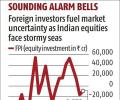
Foreign portfolio investors (FPIs) have withdrawn Rs 25,305 crore from domestic markets since September. FPIs were net sellers in the first two months of 2023, but from March to August, they purchased equities worth Rs 1.7 trillion. This selling trend has caused the National Stock Exchange Nifty Index to decline by 3.2 per cent from its September highs. FPI selling initially began in September as profit-taking but intensified due to rising US bond yields and uncertainty regarding the rate hike trajectory.

Draft Red Herring Prospectus (DRHP) filing continued to be robust in October, signifying the optimism in the initial public offer (IPO) market despite the recent turbulence in equities. In October, 17 companies filed their offer documents for IPOs. The rush in filings has made August-October 2023 the best three-month period for DRHP filings since July-September 2021.

'Midcap and smallcap indices are trading in the expensive zone.'

After Bandhan MF's US Treasury Bond 0-1 year Fund of Fund (FoF), Aditya Birla Sun Life (ABSL) MF has come out with US Treasury 1-3 Year Bond ETFs FoF and 3-10 Year Bond ETFs FoF. US bonds, which generally offer low yields, have turned attractive post the 525-basis point hike in US interest rates. According to Bloomberg data, the 1-year and 2-year US treasury yields now stand at 5.4 per cent and 5.1 per cent, respectively. Although the yields remain lower than what Indian government bonds offer, the differential has come down steeply.

Despite the uncertainties created by rising bond yields and oil prices, fund managers have been proactively deploying fresh flows into the equity market. The cash available with equity fund managers, which has remained lower at around 5 per cent in the past few months, hit a 16-month low of 4.8 per cent in September, shows a Motilal Oswal Financial Services report. Cash holdings in equity schemes had topped 6 per cent in February amid subdued equity market sentiment.

The fees charged by investment banks to manage initial public offerings (IPOs) have increased to an average 3.23 per cent of the issue size this calendar year, the highest since 2020. The average fee is up 8 per cent compared to last year, when it stood at 2.99 per cent. The investment banking fees have increased as the average IPO size has shrunk this year.

Fund managers of large-cap and equity-linked saving schemes (ELSS) have demonstrated a marked improvement in their performance over the past year, according to the latest SPIVA (S&P Indices Versus Active) report released by S&P Dow Jones Indices. In the one-year period ending June 2023, 17 per cent of active large-cap schemes outperformed the S&P BSE 100, compared to just 9 per cent at the end of June 2022. In the case of ELSS, there was a sharp improvement in performance, with 66 per cent of active schemes delivering better returns than the benchmark S&P BSE 200.
 © 2026 Rediff.com - Investor Information - Advertise with us - Disclaimer - Privacy Policy - Sitemap - Feedback - About us - Terms of use - Grievances